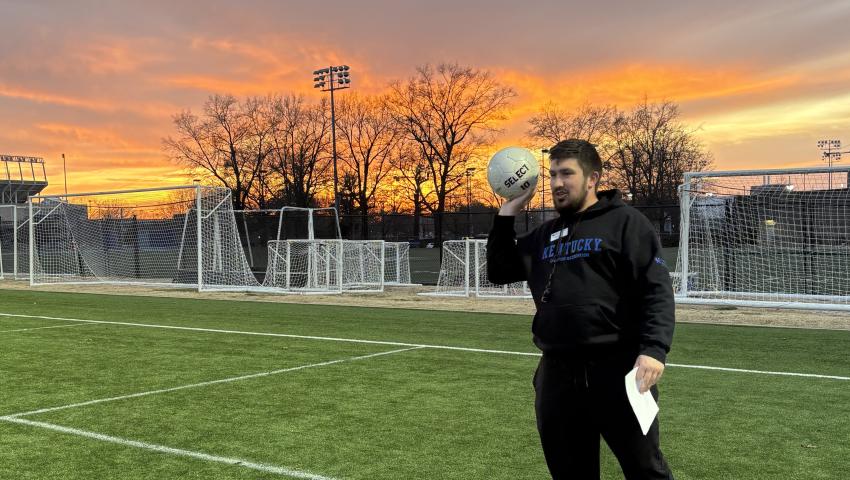
More Than the Game An Intramural Sports Q&A with Nathan
Meet Nathan, a Program Assistant for Intramural Sports at UK Campus Recreation. He is majoring in Marketing at the Gatton College of Business and has been involved with Campus Recreation since his freshman year. Through his role and participation in campus activities, Nathan has found ways to stay active, manage stress, and build a strong sense of community at UK.
Q: What role does campus recreation play in helping you build connections and find community?
A: Campus Recreation has played a huge role in helping me find my community and build connections at UK. Since I started working here in the fall of my freshman year, I’ve had the opportunity to meet and get to know so many people who have supported me and helped me grow. I’ve made lasting friendships and enjoy seeing familiar faces around campus. Whether it’s catching up about our week or talking about sports, those small interactions have made campus feel more connected.
Q: How has participating in campus recreation activities supported your physical health goals?
A: My favorite ways to stay active on campus are going for walks, participating in intramurals, and riding my bike. Since campus can feel big, walking or biking gives me a chance to stay active while also exploring different areas, like the academic side of campus, the sports complex, and the arboretum. Participating in intramurals is another way I stay active because it can be either a consistent commitment or a one-time activity.
These activities work well for me because my schedule can get busy between work and classes. Walking or biking doesn’t require a lot of time, especially when I’m already on or near campus and it allows me to fit physical activity into my day.
Q: Have you discovered any new fitness classes, sports, or activities through campus recreation that you now enjoy?
A: One new activity I’ve discovered through campus recreation is the climbing wall. Even though I have a fear of heights, I’ve challenged myself to try climbing at least one route each semester. It has been a fun way to push myself outside of my comfort zone.
I’ve also found that I really enjoy flag football. It reminds me of being a kid in middle school gym class, where the focus was simply on playing and having fun. Some people take it seriously and enjoy the competition, while others are there just to play with friends. I like that both approaches are welcome because it allows everyone to decide what the experience means to them.
Q: How do you balance staying physically active with your academic and social commitments?
A: I balance staying physically active with my academic and social commitments by setting a goal of finding at least one hour each week to do something active. I’ve learned that being active doesn’t require doing anything extreme or time-consuming. That 10–15 minutes of activity is good enough for me.
Q: How has staying active through campus recreation helped with managing stress or improving your mental well-being?
A: Staying active has helped me manage stress by giving me a break from focusing on things that feel overwhelming. When I’m stressed, it’s usually because I’ve been concentrating on the same problem or responsibility for too long. Physical activity allows me to step away and redirect my attention to something different.
Whether it’s playing a game, going for a walk, or working a shift refereeing an intramural game, these activities give me a mental reset. They help me return to my responsibilities feeling more refreshed and less stressed.
Q: Can you share an experience where being part of a recreational activity positively impacted your mood or mindset?
A: Every spring during intramural soccer season, my friends and I play together, and it always has a positive impact on my mood. Even though we aren’t the best team, coming together to play makes the experience enjoyable. Watching each other play and spending an hour doing a sport that many of us grew up playing brings back a lot of good memories.
No matter the outcome of the game, I always leave in a better mood. It’s less about winning and more about having fun, being active, and spending time with friends.
Q: What advice would you give other students about using campus recreation to support their health and wellness?
A: My advice to other students would be to take advantage of the many opportunities campus recreation offers. There is something for everyone, whether you’re looking to be competitive, try something new, or just stay active, your experience can be whatever you want it to be.


